January 7, 2026

Managing Excessive Agency: The Principle of Least Privilege for AI Agents

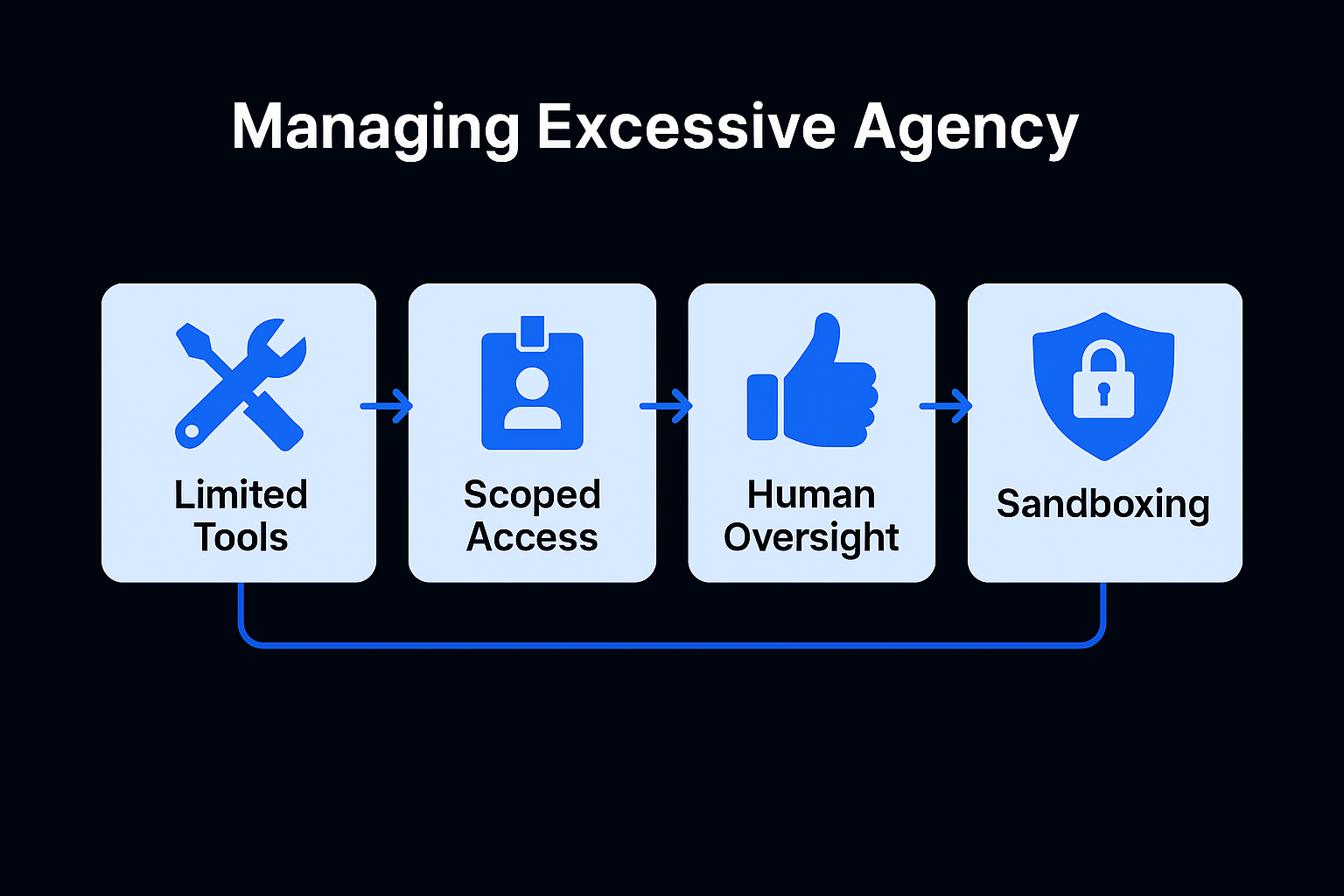
As autonomous AI agents grow more powerful, the biggest danger comes from giving them too much capability, too many permissions, or too much independence. This post explains how “Excessive Agency” emerges when agents receive broad tool access, privileged service accounts, or unchecked autonomy—creating serious security risks when combined with prompt injection or hallucinations. The solution is enforcing the Principle of Least Privilege: granular task‑specific tools, identity‑bound agents with scoped credentials, mandatory human‑in‑the‑loop approvals, and sandboxed execution environments. Proper governance ensures AI agents act safely, predictably, and only within the boundaries intended.

By 2026, the promise of "Agentic AI" has fully materialized. We are no longer just asking LLMs to write summaries; we are deploying autonomous agents to manage our calendars, optimize cloud infrastructure, and even negotiate vendor contracts. These agents are, for all intents and purposes, your new digital employees.

However, with great power comes great vulnerability. LLM06: Excessive Agency has emerged as one of the most stealthy risks in the AI Security Framework. It occurs when we give our AI agents more functionality, more permissions, or more autonomy than they actually need to do their jobs.

What is Excessive Agency? The Three Pillars of Risk

Excessive agency isn't a single bug; it’s a design flaw that manifests in three specific ways:

1. Excessive Functionality (The "Swiss Army Knife" Problem)

An agent is given access to a "toolset" that is far too broad.

  • Example: You build a "Slack Summarizer" agent. Instead of giving it a tool that only reads messages, you give it access to the full Slack API, which includes the ability to post messages, delete channels, and invite new users.

2. Excessive Permissions (The "Admin" Trap)

The agent is connected to downstream systems using a highly privileged service account.

  • Example: A support bot is connected to a customer database using an "Owner" role. While it only needs to SELECT user names, the underlying connection allows it to DROP tables or UPDATE credit balances if a prompt injection attack tricks it.

3. Excessive Autonomy (The "Checkless" Workflow)

The agent is allowed to execute high-impact actions without any human verification.

  • Example: An automated procurement agent identifies a "bargain" and spends $50,000 on hardware without a manager’s signature, triggered by a hallucination or a malicious email.

The 2026 Solution: The Principle of Least Privilege (PoLP)

To secure the "action layer" of your AI, you must move away from general-purpose bots and toward Task-Specific Agents. Here is how to implement a zero-trust architecture for your AI workers.

1. Granular Tooling: Use "Single-Purpose" APIs

Instead of giving an agent a "Shell Tool" (which can run any command), build specific, hardened functions for the exact tasks required.

  • Bad Practice: execute_shell_command(cmd: string)
  • 2026 Best Practice: get_server_uptime() or restart_service(service_name: "nginx")
  • By narrowing the "surface area" of what the AI can call, you ensure that even a compromised model cannot do significant damage.

2. Identity-Bound Agents (IAM for AI)

In 2026, every AI agent should have its own Non-Human Identity (NHI).

  • Scoped Credentials: Do not use a single "Master API Key." Use short-lived, ephemeral tokens (like JIT—Just-In-Time provisioning) that are scoped to the specific user session.
  • Contextual Access: Ensure the agent inherits the permissions of the user it is assisting. If a junior dev can’t access the production DB, their "AI Assistant" shouldn't be able to either.

3. Human-in-the-Loop (HITL) Gates

Certain actions are "too big to fail." Your architecture must include mandatory manual approvals for:

  • Financial Transactions: Anything over a specific dollar threshold.
  • Destructive Actions: Deleting files, records, or users.
  • External Communications: Sending emails to clients or posting to social media.

4. Sequestration and Sandboxing

Run your agent's execution environment in a "sealed room." Use firewalled containers that have zero access to your internal network or sensitive configuration files (like .env or SSH keys) unless explicitly required for that specific turn.

Comparison: Appropriate vs. Excessive Agency

Feature              Appropriate Agency (Secure)              Excessive Agency (Risky)

Tool Scope     Granular (e.g., read_only_email)      Broad (e.g., full_gmail_access)

Identity            Session-bound, User-scoped                Persistent "Admin" Service Account

Approval         HITL for all "Write" actions                     Full autonomy for "Write" actions

Network          Isolated Sandbox                                    Full Internal Network Access

The "Shadow AI" Threat

A new risk in 2026 is the rise of Shadow AI Agents. Employees are increasingly using unauthorized platforms (like personal Zapier or Make.com accounts) to build their own "work shortcuts." These agents often use broad OAuth grants to access corporate data.

  • The Solution: Use Agent Discovery tools to monitor your environment for unauthorized OAuth connections and enforce a centralized "Agent Governance Policy."

Technical Checklist for AI Agent Security

  • [ ] Have we replaced all "open-ended" tools (shell, fetch, python_exec) with granular functions?
  • [ ] Is every agent action logged with a "Who, What, and Why" audit trail?
  • [ ] Are we using ephemeral, short-lived tokens for all agent-to-API calls?
  • [ ] Is there a mandatory "Human Review" step for all destructive actions?
  • [ ] Do we have a "Kill Switch" that can instantly revoke all agent permissions in case of a breach?

Conclusion

Giving an AI agent "Admin" rights is the 2026 equivalent of leaving your master keys in the front door lock. To reap the benefits of automation without the catastrophic risks, you must build with Least Privilege at the core. Treat your agents as powerful tools that require constant, identity-based supervision.

Managing agency is a vital component of your overall AI Security Framework. Once you’ve mastered the permissions of your agents, the next challenge is ensuring the "instructions" they follow aren't being stolen—which leads us to the risk of System Prompt Leakage.

More blogs