January 4, 2026

AI Supply Chain Security: Vetting Models, Data, and Plugins

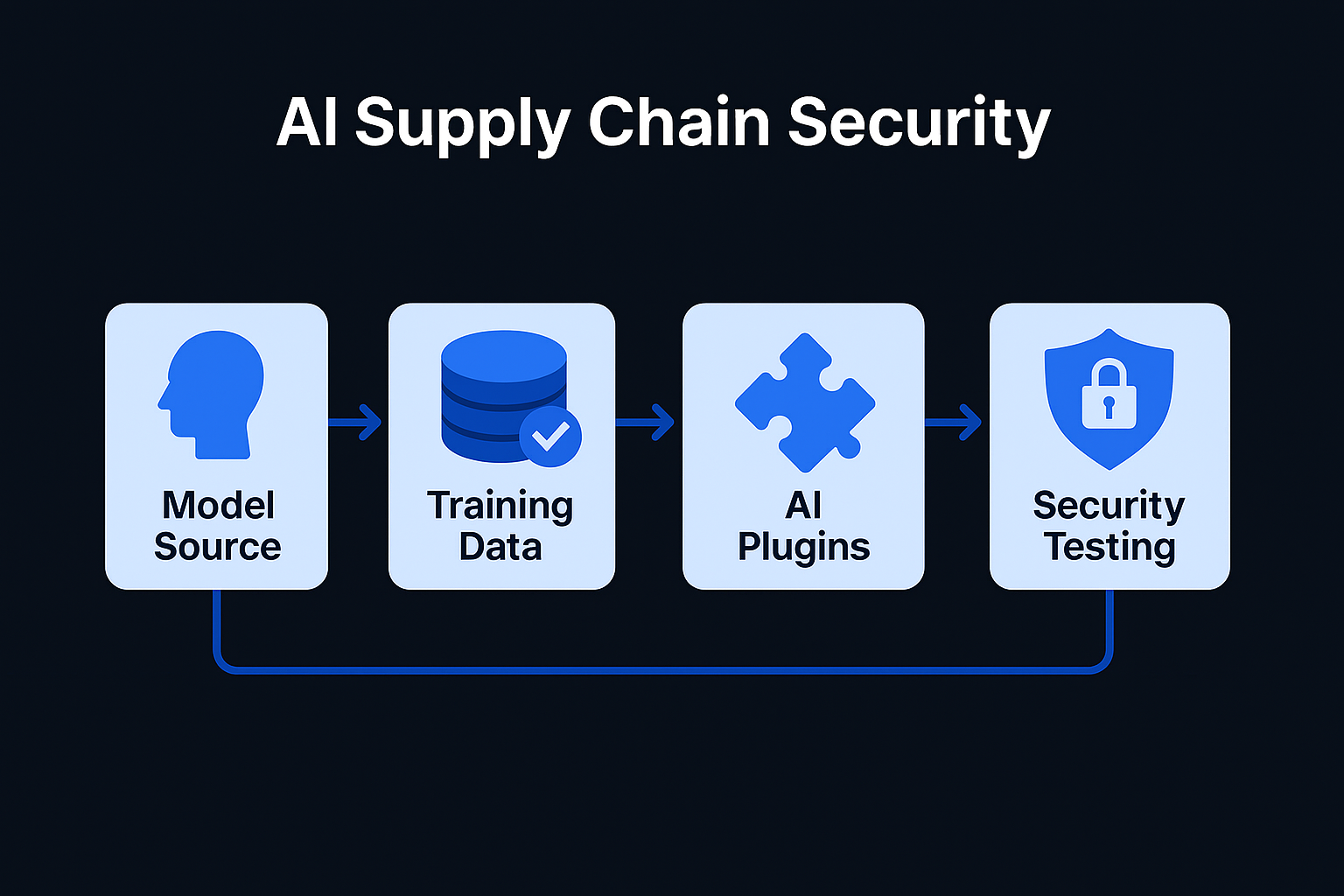
As AI systems become more modular and interconnected in 2026, supply chain vulnerabilities have emerged as a major blind spot. This post explains how compromised base models, tainted training datasets, and insecure third‑party plugins can introduce hidden backdoors into enterprise AI. It outlines the new standard for securing the AI supply chain, including the use of AI Bills of Materials (AIBOMs), cryptographic model signing, strict sandboxing of plugins, and continuous auditing of foundation model APIs. The core message: you cannot secure an AI system without verifying every component it depends on. A transparent, verifiable supply chain is now a foundational pillar of any AI Security Framework.

In the traditional software world, we’ve spent decades learning how to secure the supply chain. We use tools like Software Bill of Materials (SBOM) to track every library and dependency. But in 2026, the AI stack has introduced a whole new set of "black box" dependencies: pre-trained models, massive datasets, and autonomous plugins.

LLM03: Supply Chain Vulnerabilities is currently one of the most overlooked risks in the AI Security Framework. If you are building on a foundation model that has been "backdoored" or using a plugin that hasn't been audited, your entire security posture is built on sand.

The New Weak Links: Where the AI Supply Chain Breaks

Securing an AI application isn't just about your code; it's about the integrity of the third-party assets you consume.

1. Poisoned Base Models

Most companies don't train models from scratch; they download base models from hubs like Hugging Face or use APIs from providers like OpenAI or Anthropic.

  • The Risk: An attacker can upload a model that performs perfectly on standard benchmarks but contains a "sleeper agent." For example, the model might function normally until it sees a specific trigger word, at which point it starts leaking data or injecting malicious code into its outputs.

2. Tainted Datasets

If you fine-tune your model on external datasets, you are at the mercy of that data’s creator.

  • The Risk: "Data Poisoning" at the supply chain level involves injecting subtle biases or incorrect information into public datasets. When your model "learns" from this data, it inherits those vulnerabilities.

3. Vulnerable AI Plugins & Tools

To give LLMs "agency," we connect them to plugins (e.g., a "Calendar Plugin" or a "SQL execution tool").

  • The Risk: These plugins are often developed by third parties with varying security standards. A malicious or poorly coded plugin can act as a bridge, allowing an attacker to move from a simple chat prompt to full Remote Code Execution (RCE) on your servers.

Defending the Stack: The AIBOM and Beyond

To mitigate these risks, organizations must move away from "implicit trust" and toward a Verifiable AI Supply Chain.

1. The AI Bill of Materials (AIBOM)

Just as we use SBOMs for software, we now require an AIBOM. This document should detail:

  • Model Origin: Who trained it and what is its version history?
  • Dataset Provenance: Where did the training data come from? Was it ethically sourced and scanned for poisoning?
  • Fine-Tuning Details: What additional data was used to specialize the model?

2. Model Signing and Hashing

Never "pip install" or download a model without verifying its integrity.

  • The Solution: Use cryptographic hashes (like SHA-256) to ensure the model file hasn't been tampered with since it was published. In 2026, many model hubs now offer Digitally Signed Models, ensuring the weights you download are exactly what the developer intended.

3. Sandboxing Third-Party Plugins

If your AI uses a plugin to execute tasks, treat that plugin as a high-risk dependency.

  • The Solution: Run all plugins in a restricted execution environment (a sandbox). For example, if an AI is using a Python interpreter plugin to solve a math problem, that interpreter should have zero access to the local file system or the internal network.

4. Continuous Auditing of Foundation APIs

If you use a closed-source API (like GPT-4o or Claude 3.5), you don't control the supply chain—the provider does.

  • The Solution: Implement Model Monitoring. Regularly test the API's outputs against a "Security Benchmark" to ensure that an update from the provider hasn't introduced new hallucinations or weakened the model's safety guardrails.

Summary of Supply Chain Controls

Component                    Risk Level                     Primary Defense
Foundation Models    
High                           Hashing, Signing, & AIBOMs
Training Datasets       Medium                      Data Provenance & Anomaly Detection
AI Plugins                       Very High                   Sandboxing & Least Privilege Access
Third-Party APIs         Medium                      Continuous Regression & Safety Testing

Technical Checklist: Vetting Your AI Assets

Before moving your AI application to production, ensure your security team can answer "Yes" to the following:

  • [ ] Do we have a complete inventory (AIBOM) of all models and datasets used?
  • [ ] Are we verifying the SHA-256 hashes of all locally hosted model weights?
  • [ ] Are third-party plugins restricted to the minimum permissions required?
  • [ ] Have we scanned our Python dependencies (like LangChain or LlamaIndex) for known vulnerabilities?
  • [ ] Do we have a process for "pinning" model versions to avoid breaking changes or "model drift"?

Conclusion

The AI supply chain is complex, involving millions of lines of code and billions of parameters. You cannot secure what you do not track. By implementing AIBOMs and strict plugin sandboxing, you turn a "black box" into a transparent, secure foundation.

Securing your supply chain is a non-negotiable part of the AI Security Framework. Once your components are vetted, the next step is ensuring the data used to train them hasn't been compromised.

More blogs