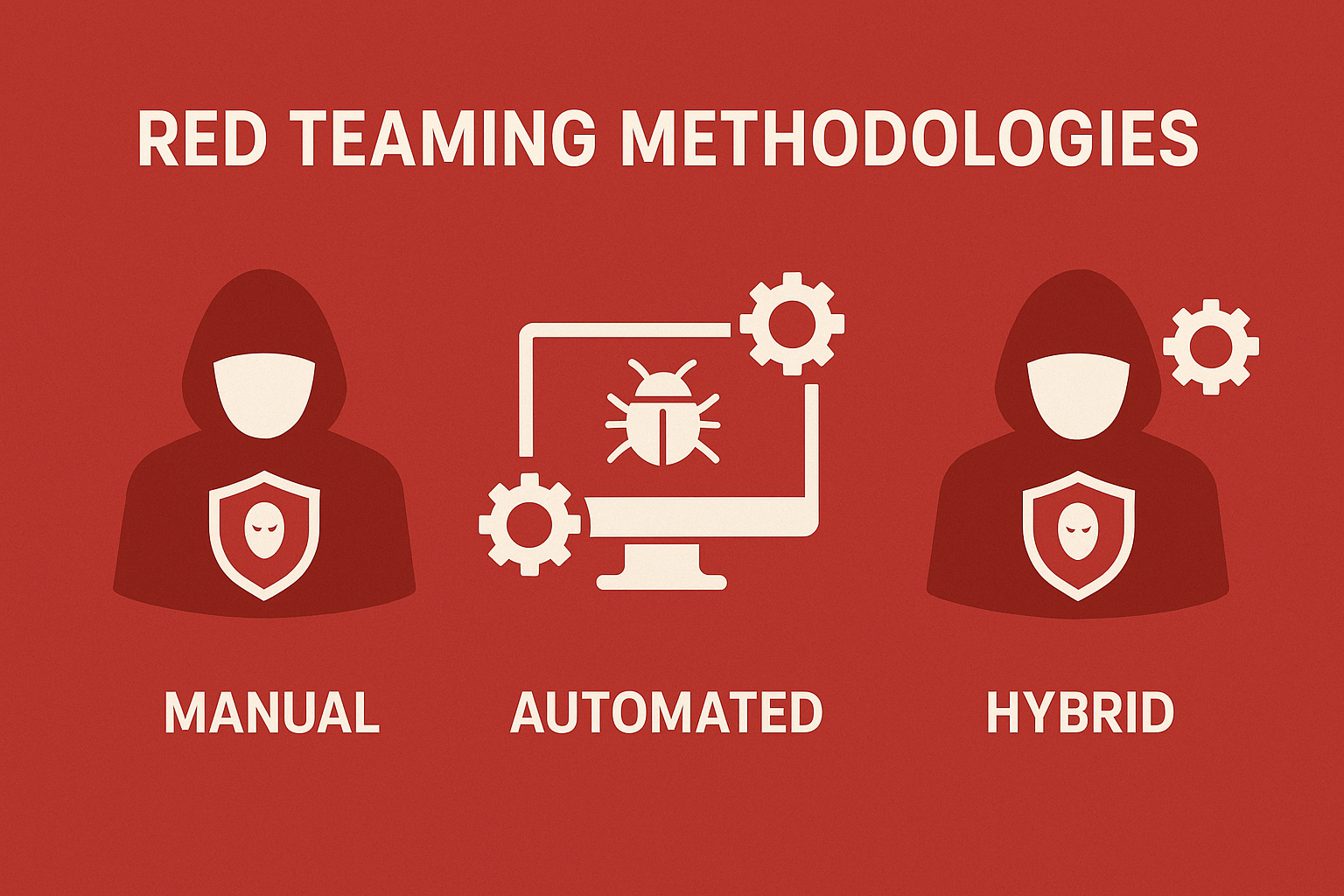
Manual Red Teaming: Human Creativity at the Core
Manual red teaming relies on skilled experts who simulate sophisticated adversaries through hands-on interaction with the target system.
Key characteristics include:
- Crafting nuanced, context-aware prompts and attack chains
- Adapting tactics in real time based on model responses
- Exploring subtle socio-technical harms such as cultural biases, emotional manipulation, or child safety edge cases
- Role-playing complex scenarios that require understanding intent, ethics, and real-world plausibility
- Evaluating subjective qualities like output harm severity or refusal appropriateness
Advantages stand out in several areas:
- Uncovers novel or low-frequency vulnerabilities that automated scripts miss
- Handles ambiguity and emergent behaviors requiring human judgment
- Excels at chaining exploits across sessions or modalities
- Provides rich qualitative insights for root-cause analysis
Limitations constrain its standalone use:
- Time-intensive and resource-heavy
- Difficult to scale across thousands of test cases
- Prone to human bias or fatigue
- Challenging to reproduce consistently without detailed documentation
Manual efforts shine during initial exploration of frontier models, high-stakes domain testing (finance, healthcare, legal), and validation of nuanced alignment failures.
Tools often support manual workflows, including prompt templates, session logging, and scoring rubrics, but the core value derives from expert intuition and adaptability.
Automated Red Teaming: Scale and Systematic Coverage
Automated methodologies leverage scripts, frameworks, and sometimes attacker LLMs to generate, execute, and evaluate large volumes of adversarial inputs programmatically.
Common techniques encompass:
- Prompt fuzzing and mutation (paraphrasing, encoding obfuscations, token-level perturbations)
- Template-based attack generation using known jailbreak patterns
- Optimization algorithms (gradient-based suffixes, Bayesian search) for efficient bypass discovery
- Multi-turn simulation via agentic red teamers that refine strategies iteratively
- Benchmark suites measuring attack success rate (ASR) across risk categories
Strengths drive adoption in mature programs:
- Achieves broad coverage quickly, testing thousands to millions of variations
- Delivers repeatable, quantifiable results with clear metrics
- Integrates seamlessly into CI/CD pipelines for regression testing
- Identifies systematic weaknesses in guardrails or filtering layers
- Cost-effective for ongoing monitoring and drift detection
Drawbacks include:
- Struggles with highly creative or context-dependent attacks
- May produce false positives requiring human triage
- Limited in discovering truly novel exploits without human-guided evolution
- Over-relies on predefined taxonomies, missing zero-day behaviors
Popular open-source tools like PyRIT, Garak, and HARM enable large-scale fuzzing and multi-turn probing, while commercial platforms add enterprise features such as dashboarding and integration.
Automated methods excel at baseline vulnerability scanning, known-pattern regression, and stress-testing robustness under volume.
Hybrid Red Teaming: The Recommended Gold Standard
Hybrid approaches blend manual insight with automated scale, creating feedback loops that amplify the strengths of both while mitigating weaknesses.
Typical workflows follow this structure:
- Automated scanning generates broad attack sets and flags high-confidence failures
- Human experts investigate anomalies, chain discoveries into realistic scenarios, and craft sophisticated variants
- New attack patterns feed back into automated suites for wider coverage and regression checks
- Iterative cycles refine defenses through targeted mitigation and re-testing
Benefits compound across dimensions:
- Achieves higher vulnerability discovery rates (often 2-3x compared to single methods)
- Balances breadth (automation) with depth (manual validation)
- Accelerates identification of unknown-unknowns through human-guided evolution of automated agents
- Supports continuous testing in production-like environments
- Produces richer documentation for governance, audits, and regulatory reporting
Implementation best practices include:
- Define clear handoff points between automated and manual phases
- Use LLM judges for initial scoring, reserving human review for borderline or high-severity cases
- Maintain attack libraries that evolve with discoveries
- Incorporate diverse teams to reduce blind spots in manual phases
- Track metrics like ASR, time-to-discovery, and fix coverage over cycles
Industry leaders, including frontier model developers, adopt hybrid strategies extensively, combining tools like attacker LLMs with expert red teams for comprehensive evaluation.
Choosing and Combining Methodologies Effectively
Selection depends on several factors:
- Stage of development — early prototyping favors manual; production favors hybrid with heavy automation
- Resource availability — limited teams start automated; mature programs invest in hybrid
- Risk profile — high-stakes applications demand manual depth; broad consumer tools prioritize automated scale
- Threat model — novel jailbreaks need manual creativity; prompt injection variants suit automation
Practical integration tips enhance outcomes:
- Start automated for quick wins and triage
- Follow with manual deep dives on flagged issues
- Automate regression of manually discovered exploits
- Run periodic full manual exercises for strategic shifts
- Document everything for traceability and learning
Conclusion: Evolving Toward Adaptive, Layered Adversarial Testing
Manual, automated, and hybrid methodologies each play essential roles in modern GenAI red teaming. Manual delivers irreplaceable creativity and nuance. Automated provides indispensable scale and consistency. Hybrid unites them into a powerful, adaptive system that keeps pace with rapidly advancing models and threats. For a comprehensive overview of The Complete Guide to GenAI Red Teaming, refer to the blog The Complete Guide to GenAI Red Teaming: Securing Generative AI Against Emerging Risks in 2026.
Related Articles: